
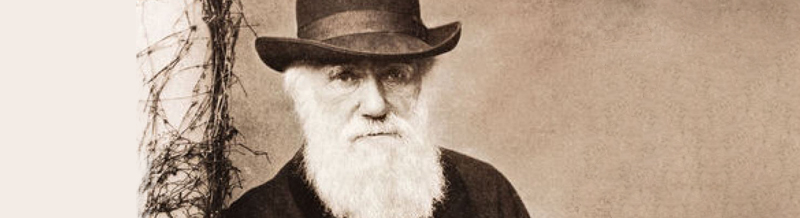

When Italy entered into the First World War, Reinhard Dohrn, son of Anton and at the time Director of the Station, and the German assistants had to leave the country. The station, as private entity belonging to a German citizen, was placed under national control. In 1916 the station was solemnly inaugurated as an 'Italian Institute' and placed under the direction of a national committee.
At the end of the war, after a period of uncertainty, Benedetto Croce, then Minister of Education, in a speech to the Senate on December 9, 1920, suggested placing the Zoological Station again under the responsibility of the Dohrn family, the only way, according to the Neapolitan philosopher, to guarantee the institution its scientific links and its functionality. In October of 1923 its legal status was redefined and the Stazione Zoologica became an 'Ente Morale' (a semi-private institution), under the surveillance of the Ministry of Public Instruction and directed by a Board of Directors, chaired by the Mayor of Naples. Reinhard Dohrn was nominated ‘managing director and administrator’.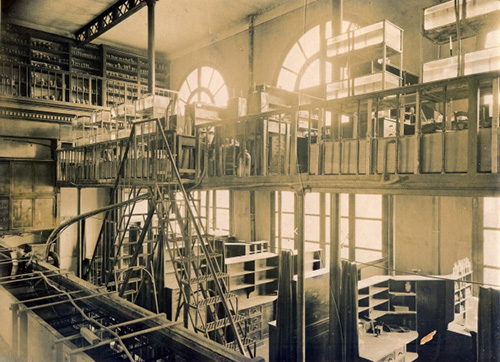 The new institutional structure maintains the international status of the Stazione Zoologica, fostering contacts among researchers of different countries and encouraging their presence in Naples, thanks to a total freedom of research and a technical structure effective, able to create ideal working conditions and providing all the research material needed.
The scientific activities of the Stazione Zoologica in the interwar period show a great continuity with the previous period. Systematics remains a priority. The physiology of the embryo, the regeneration, research of biochemical components in marine organisms and their quantitative changes during embryonic development, the study of embryonic gradients, research on bioluminescence and photogenesis, hereditary symbiosis continue to be points of aggregation, while the wealth of the Gulf of Naples, with its flora and diversity of animals both superficial and abyssal forms, favored the development of a new ecological approach, centered on alimentary chains, the complex of organisms, in connection with the biological and physical-chemical environment. And, as in previous periods, the Stazione Zoologica is the ideal place for experimentation of new technologies applied to research, such as the use of cinema for the study of experimental embryology, the first experience of scientific cinematography (Istituto Luce) and research supported by Kodak on gels of animal origin for film.
Once again, however, the main thrust to scientific innovation comes from embryology. The turning point in this kind of research can be identified in a classic article of 1924 in which Hans Spemann and Hilde Mangold had begun to study the morphogenetic processes leading to the formation of the eye in amphibians. This research program is developed further in the following years, through a very complex series of experiments in tissue transplants, many of which are made in Naples, where Spemann worked quite often, accompanied by a substantial group of assistants.
In the 20s and 30s the physiological and biochemical research continues to play a major role in the scientific life of the Stazione Zoologica. Albrecht Kossel and the Svedberg, founders of nucleic acid chemistry, work equally to the Zoological Station, as Jean Brachet, that at this time develops the cytochemical techniques for localization of nucleic acids into cells and embryo. Otto Meyerhoff (a future Nobel laureate) studying muscle metabolism, focusing interest on chemical stimulation of the muscle fiber. In 1935, Zénon-Marcel Bacq and Francesco Paolo Mazza demonstrate the presence of acetylcholine in the ganglia of the optical octopus (Octopus), and identify the substance chemically. The contribution of Bacq and Mazza is a milestone in the history of chemistry of nerve transmission, the first direct proof of its existence in the nervous tissues. Bacq, a pharmacologist from Belgium, in collaboration with Francesco Ghiretti employed cephalopods to develop endocrinology, using adrenaline-like agents.
The Zoological favored another important progress in neurobiology, the discovery of Ernst Scharrer of the phenomenon of what has become known "neurosecretion," the elaboration and secretion of hormones from by nerve cells.
What may be called the modern era of research on cephalopod research begun in Naples with the research of Enrico Sereni, who conducted major experiments on the chromatophores and salivary hormonal secretion. Sereni also works on the peripheral nervous system of cephalopods, in collaboration with the young British researcher John Z. Young, who founded another line of research, that will become characteristic of the Stazione Zoologica, pursued for decades and almost uninterrupted. Working with Sereni on the Octopus, Young discovered by chance the giant axon this became a fundamental tool in exploring nerve conduction. The sections of the brain and giant fibers of octopus and cuttlefish, created by Young at the Stazione Zoologica in 1936 showed the possibility of studying higher nervous activities, such as learning and memory.
The Stazione Zoologica remains virtually closed between 1943 and 1945, with a very small number of researchers and technicians. The Aquarium reopened to the allied troops in December 1943. The Villa Comunale was left by Allied troops on May 1, 1944 and the activity of the station can begin again. The Library was relocated to its place at the end of 1944. After the liberation of Rome, June 4, 1944, contacts are established with the Ministry of Education and the National Research Council, who supported the station consistently. This will create a "Center for Biological Studies", under the direction of Joseph Reverberi, whose main purpose is to create training grants for young biologists. After 1950, the National Science Foundation, newly created, the Lilly Endowment and the Rockefeller Foundation increase considerably their engagement with the Stazione Zoologica. The scientific prestige of the Stazione Zoologica and its location in the postwar period made it rapidly a privileged place for the realization of conferences and scientific meetings. This was also an opportunity for Italian scientists to enter the international circuit. The station hosts important conferences on embryology and genetics, mutagenesis, on neurosecretion. In 1951 the Stazione Zoologica held a conference on the application of X-rays to the study of biological problems, in particular the study of the submicroscopic structure of protoplasm. In this conference, Wilkins shows a figure of X-ray diffraction of the crystalline DNA and this stimulates JD Watson, who attended the meeting, to start its work on nucleic acids, that will take him with Francis Crick's discovery of the double helix.
The Stazione Zoologica did not have an in-house research program, apart from Anton Dohrn’s own project, and therefore its structure reflected the major interests of the visiting scientists. However, Dohrn recognized the significance of different sections of science, and the way in which they interact and complement each other. In such a way he was able to create a structure perfectly in tune with the main scientific issues of the time and to bring the best researchers to Naples. Embryology, Comparative Anatomy, Systematic Botany and Zoology, including natural history, ecology and the study of behavior, were the main fields of research in the early decades of the Stazione Zoologica’s activity.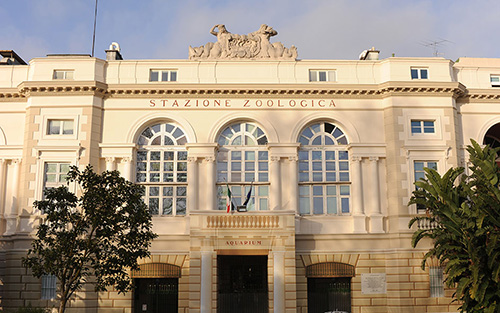 Founded in an era when morphological studies predominated, paradoxically the Zoological Station in 1880 becomes a stronghold of the revolt against Haeckelian phylogenetic embryology. The new generation of biologists is placed in an extremely critical attitude towards the morphological tradition and supports the implementation of a new experimental method to the problems of development, thus giving rise to a new era in the study of embryonic development. The different stages of embryonic development are not observed to obtain the evidence in favor of the phylogenetic inferences, these are not a tool of explanation but become themselves processes to explain, by identifying their causes. Experimental addresses make their way into other areas, such as the study of the cell, the theory of inheritance, the same theory of evolution. The function replaces the objective form of scientific inquiry as an explanatory principle. An object of study, a marine animal of course, is particularly suitable for this experimental research, the sea urchin. With this new tool and new experimental methodology the famous “injury experiment” was conducted in 1888. With a thin needle, Wilheim Roux destroys the nucleus of one of the two cells formed after the first segmentation of the zygote: the undamaged embryo continued its normal development of producing 'half an embryo', demonstrating that cell division is qualitative and each of the primary cells has a predetermined fate, independent from the presence of other cells and from the later stages of development.
Some years after Jacques Loeb realized in Naples artificial insemination, showing that the sea urchin egg can start development when exposed to an acid or to an increase in osmotic pressure. This experimental ' chemical parthenogenesis ' has a great impact on the scientific community and public opinion. Someone even suggested that women should avoid swimming in the sea, because of the risk of chemical parthenogenesis.
In 1889 the German biologist Theodor Boveri began his experiments in Naples on 'hybridisation' of different species of sea urchin, in order to determine whether the core, the protoplasm or both determine inheritance and development. Boveri demonstrates the dominant role of the nucleus in heredity and genetic diversity of the chromosomes, establishing a link with the Mendelian theory, which had just been rediscovered and proposing an initial 'chromosome theory of heredity’.
Between 1908 and 1914, Otto Warburg spent several periods at the Stazione Zoologica, where he carried out his first independent research on the oxygen consumption by the urchin egg after fertilization. In 1909 he discovered that iron is essential for the development of the larval state, thus beginning a new research program on cellular breathing, research that later won him the 1931 Nobel Prize for his discovery of the cytochrome oxydase.
Between 1866 and 1945 Thomas Hunt Morgan works at the Stazione Zoologica before turning to genetics and create the 'Drosophila Group ', giving rise to the chromosome theory of inheritance.
Nel 1889 il biologo tedesco Theodor Boveri inizia a Napoli i suoi esperimenti di "ibridazione" fra specie diverse di riccio di mare, allo scopo di stabilire se è il nucleo, il protoplasma o entrambi a determinare l'eredità e lo sviluppo. Boveri dimostra il ruolo dominante del nucleo nella trasmissione ereditaria e la diversità genetica dei cromosomi, stabilendo un legame con la teoria mendeliana, che era stata appena riscoperta e proponendo una prima "teoria cromosomica dell'eredità".
Fra il 1908 e il 1914, Otto Warburg trascorre diversi periodi alla Stazione, dove realizza la sua prima ricerca indipendente sul consumo di ossigeno da parte dell'uovo di riccio dopo la fecondazione. Nel 1909 egli scopre che il ferro è essenziale per lo sviluppo dello stato larvale, iniziando così un nuovo programma di ricerca sulla respirazione, che gli varrà il premio Nobel nel 1931 per la scoperta della citocromoossidasi.
Tra il 1866 e il 1945 Thomas Hunt Morgan lavora alla Stazione prima di dedicarsi alla genetica e creare il "Gruppo della Drosophila", dando origine alla teoria cromosomica dell'eredità.
PhD Program Open University - Stazione Zoologica Anton Dohrn
Duration of Ph.D. Thesis & Financial Support
Students are expected to complete their thesis within three years, with the possibility of a fourth year without salary, to write up the thesis (should this be necessary). The gross salary is € 16.000,00 per year for three years from which taxes (approximately 18%) will be subtracted. Students are liable to an annual registration fee to be paid to the Open University (not to the Stazione Zoologica).
The Stazione Zoologica will cover the registration fee for three years.
Admission Requirements
Applicants must hold or be in the process of receiving (within November 28th 2022):
1. an advanced degree such as a Master of Science (M.Sc.) or its equivalent in a scientific area coherent with the project proposed;
and, where English is not the applicant’s first language,
2. an IELTS certificate (dated within the last two years) with scores that meet the minimum requirements of 6.5 overall score, and no less than 6.0 in any of the four elements (reading, writing, listening and speaking).
Alternative language certificate accepted:
- a degree completed either in the UK or in one of the majority English speaking countries listed listed below is also considered a proof of English proficiency:
• Antigua and Barbuda
• Australia
• The Bahamas
• Barbados
• Belize
• Dominica
• Grenada
• Guyana
• Ireland
• Jamaica
• Malta
• New Zealand
• St Kitts and Nevis
• St Lucia
• St Vincent and the Grenadines
• Trinidad and Tobago
• United States of America
The PhD Program is in English. Where English is not the applicant’s first language, he/she must demonstrate sufficient proficiency in the English language to support successful study at research degree standard. Fluency in spoken English will be assessed during the interview and is a strict requirement.
Thesis Supervision
Each student is assigned a Supervision Team before the start of the internship, whose appointment is proposed by the direct supervisor (Director of Studies) and approved by the Open University. The Supervision Team is composed at least by:
- one direct supervisor (Director of Studies), who will guide the student during the whole thesis work and will supervise the student on a daily basis;
- one external supervisor, (not belonging to SZN staff), appointed at the beginning of the internship, who will offer an independent assessment of the student progress annually.
It is possible to appoint additional members of the supervision team, as Internal (SZN staff), External (non-SZN staff) Supervisors or Advisors.
Courses and Training
PhD-level training is offered annually (2-3 courses per year) on scientific topics and complementary skills, together with specialized seminars (12-14 per year) offered by scientists invited by the SZN on different topics. Attendance to courses, seminars and all PhD Program’s events is mandatory. Students are required to follow all training events as well as the seminars and the tutorials before the seminars in order to qualify for the degree. All courses, seminars and tutorials are held in English.
Selection procedure
Applications will be evaluated by a Selection Committee on the basis of the candidate’s Education grade, experience and skills in the project area, motivation, reference letters and English proficiency.
Candidates will be notified by email the results of the applications evaluations.
Selected candidates will be invited for interviews.
The interviews (remote internet video conference is allowed) will be conducted in English and candidates will be asked to present their previous scientific experience and to discuss the project to which they are applying to. Their proficiency in English will be also tested.
Candidates with disabilities should please detail any eventual facility they require to participate in the interview. Every effort will be made to ensure that they can participate on an equal basis with other candidates and all reasonable arrangements requested by disabled candidates will be adopted.
The final appointment of the successful candidates is subject to the approval of the Open University.
Final candidates are expected to start their internship on December 1st.
If you have any question regarding the application process, please, contact Gabriella Grossi at phdszn(at)szn.it.
Special needs
Candidates with disabilities should please detail in the application form, any eventual facility they require to participate in the interview. Every effort will be made to ensure that they can participate on an equal basis with other candidates and all reasonable arrangements requested by disabled candidates will be adopted.
Practical information
The SZN does not offer lodging or financial support for moving expenses, neither parental support.
Students are offered practical support for their settling in Naples through theHigher Education & University Liaison Office that can be contacted at phdszn(at)szn.it.
Read SZN PhD Progam Body of Rules and Fellowship and tax information.
DEADLINE November 3rd 2022 - h. 12.00
PLEASE NOTE NEW DATE OF INTERVIEW
Interviews of selected candidates will be held in videoconference on November 11th 2022 on November 14th 2022 at h. 14:30 at the link:
https://us02web.zoom.us/j/89239275003?pwd=Z1Q2eUVOWEtIWXRVdnlBOW4wVkp4Zz09
Updated on 14/11/2022

Coming soon
In Progess


Copyright © 2015 by Stazione Zoologica Anton Dohrn Napoli - Italy
Villa Comunale, 80121 Napoli - Tel.+39 081 5833111 - C.F./P.IVA : IT 04894530635 - PEC: ufficio.protocollo(at)cert.szn.it